
- Agri Spray Drones
- Honeysuckle Control With Drones: Faster, More Efficient Management
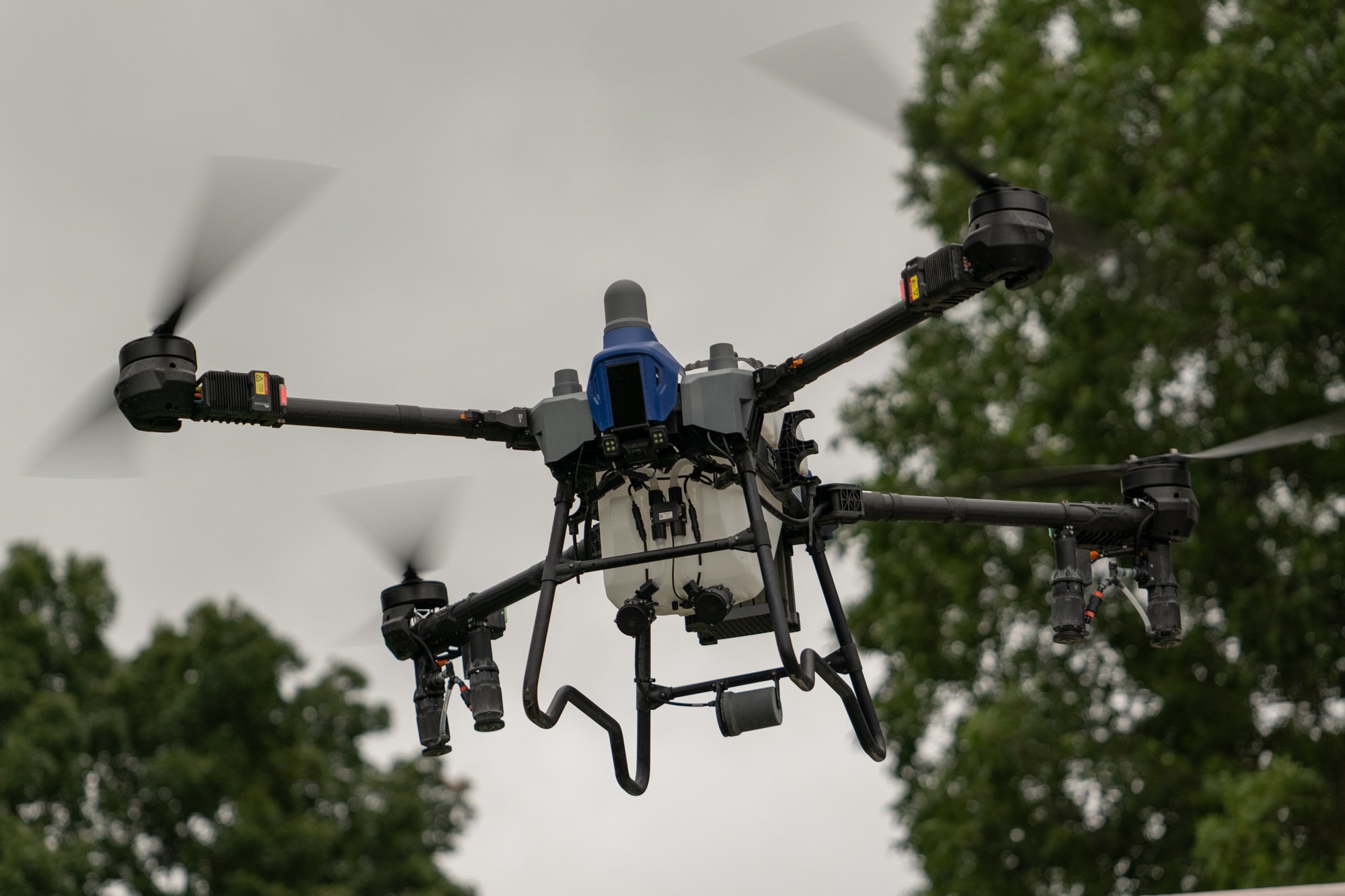
Honeysuckle Control With Drones
Honeysuckle is one of those problems that often goes unnoticed—until it’s everywhere.
Across Missouri and much of the Midwest, bush honeysuckle has spread rapidly through wooded areas. It stays green longer than native plants, grows aggressively, and crowds out everything beneath it. As a result, native vegetation disappears, wildlife habitat declines, and effective land management becomes increasingly difficult.
To better understand both the problem and potential solutions, a recent project brought together Taylor Moreland and the Missouri Department of Conservation to evaluate honeysuckle control with drones as a tool for invasive species management.
Why Bush Honeysuckle Is a Challenge
Bush honeysuckle is not native to the Midwest. It was introduced from Asia in the 1960s and 1970s and commonly planted around homes and landscapes. Over time, it escaped cultivation and spread into surrounding timber, where it quickly took over.
Once established, honeysuckle blocks sunlight from reaching the forest floor. Native plants struggle to grow, reducing food sources and cover for wildlife. Deer lose forage and bedding areas, while turkeys lose nesting habitat. As honeysuckle spreads, maintaining healthy forests becomes more labor-intensive and costly.
Timing Makes the Difference
One of the most critical factors in successful bush honeysuckle control is application timing.
This project took place in mid-November, after most native trees had dropped their leaves and entered dormancy. Honeysuckle, however, was still actively growing and holding green foliage.
That creates a narrow application window—typically one to two weeks—where honeysuckle can be treated with minimal risk to native species. For those familiar with agricultural spraying, the concept is simple: proper timing often determines whether a treatment succeeds or fails.
Traditional Honeysuckle Control Methods
Traditionally, honeysuckle is controlled using backpack sprayers. Crews walk through dense timber and manually spray individual plants.
While effective, this method is slow, labor-intensive, and expensive. A typical crew may consist of three to five people, often costing around $100 per hour per person. Treating a 15-acre site can take several days and cost close to $10,000.
Evaluating Drone Spraying for Invasive Species
Drone spraying for invasive species offers a more efficient alternative, particularly in rough or heavily wooded terrain.
For this aerial herbicide application, the setup included:
-
Glyphosate with AMS
-
10 gallons per acre
-
16 feet per second flight speed
-
300-micron droplet size
-
Approximately 15 feet above the canopy
The objective was to move spray through the canopy and reach honeysuckle growing below. Even with reduced leaf cover on native trees, the drone maintained consistent height and uniform coverage across the treatment area.
Efficiency in the Field
The 15-acre site was treated in approximately three hours using drone application for land management.
By comparison, backpack crews would require at least two full days to complete similar work under the same conditions. From a cost standpoint, drone operators performing this type of forestry drone spraying are charging roughly $80 per acre, placing a project of this size near $1,200.
The reduction in labor, applicator exposure, and overall time makes drone spraying an attractive option for conservation agencies, land managers, and contractors.
Looking Ahead
Final results will be evaluated next spring.
Because honeysuckle naturally drops its leaves later in the fall, true efficacy is measured at green-up. If treated areas fail to regrow honeysuckle, the application can be considered successful.
From an operational perspective, the project demonstrated that drone herbicide application can be a reliable and efficient tool for invasive species management. For conservation organizations, landowners, and applicators, drone spraying offers a practical way to reclaim land while reducing costs and labor demands.
Follow-up evaluations will take place next spring to assess long-term results.
Be sure to watch our video for all the details!
Read On


How long can a sprayer drone fly on one battery charge?
Flight times per battery charge vary depending on battery and ambient temperature, payload weight,...

How To Measure the ROI of Drone-Based Farming
In recent years, drone-based farming has emerged as a transformative development in agriculture,...